4 min read
Published
Private Lending: Clear Purpose, Credible Exits and Common Sense
Property security matters, but a sound private loan starts with two questions: what the funding needs to achieve, and how it will be repaid.
- Steven Galdona, Director of Credit & Operations

For brokers and borrowers. Business-purpose lending.
A sound private lending transaction starts with two questions: what does the borrower need the funding to achieve, and how will the loan be repaid?
Property security is important. But understanding the borrower's purpose, circumstances and repayment strategy is fundamental to a considered lending decision.
Solomons Capital is a Brisbane-based private lender working nationally with brokers and borrowers on non-NCC, property-backed funding for business and commercial purposes, including first and second mortgages. For brokers and borrowers, including property investors, five areas deserve particular attention.
1. Loan purpose: what the funding needs to achieve
The purpose must be clear from the outset. Whether the borrower is buying a property, refinancing existing debt, completing a development or accessing working capital, the facility needs to support a defined and achievable outcome.
That means understanding more than the amount requested:
- Why is the funding needed?
- How will it be applied?
- What will it allow the borrower to accomplish?
- Is the amount enough to complete that objective?
A facility that settles but leaves the borrower without enough funding to carry out the plan has not addressed the underlying need. The amount, structure and term should reflect the purpose and give the borrower a realistic chance of achieving it.
2. The exit: how repayment will actually happen
The exit strategy deserves as much attention as the funding request.
"Refinance" or "sale of property" is a starting point for the assessment. A credible exit needs supporting evidence, realistic timing and an understanding of what could stop it from happening.
- Refinance: the borrower's servicing capacity, credit position and ability to meet the incoming lender's requirements.
- Sale: the property's marketability, the expected net proceeds, and enough time for marketing and settlement.
- Business cash flow: whether the business can generate enough surplus cash within the loan term.
Equity provides security; it does not, by itself, provide a way to repay. An alternative exit should also be considered in case the preferred one is delayed or becomes unavailable.
3. Valuation and payout figures: the real funding position
An estimated property value and an approximate debt balance are not enough to build a refinance on. The assessment needs to reconcile the valuation, the acceptable loan-to-value ratio (LVR), and the actual amount needed to discharge the existing facility.
Accrued interest, default interest, discharge fees and other costs can increase the payout. On the new facility, establishment costs and any retained interest reduce the net funds available.
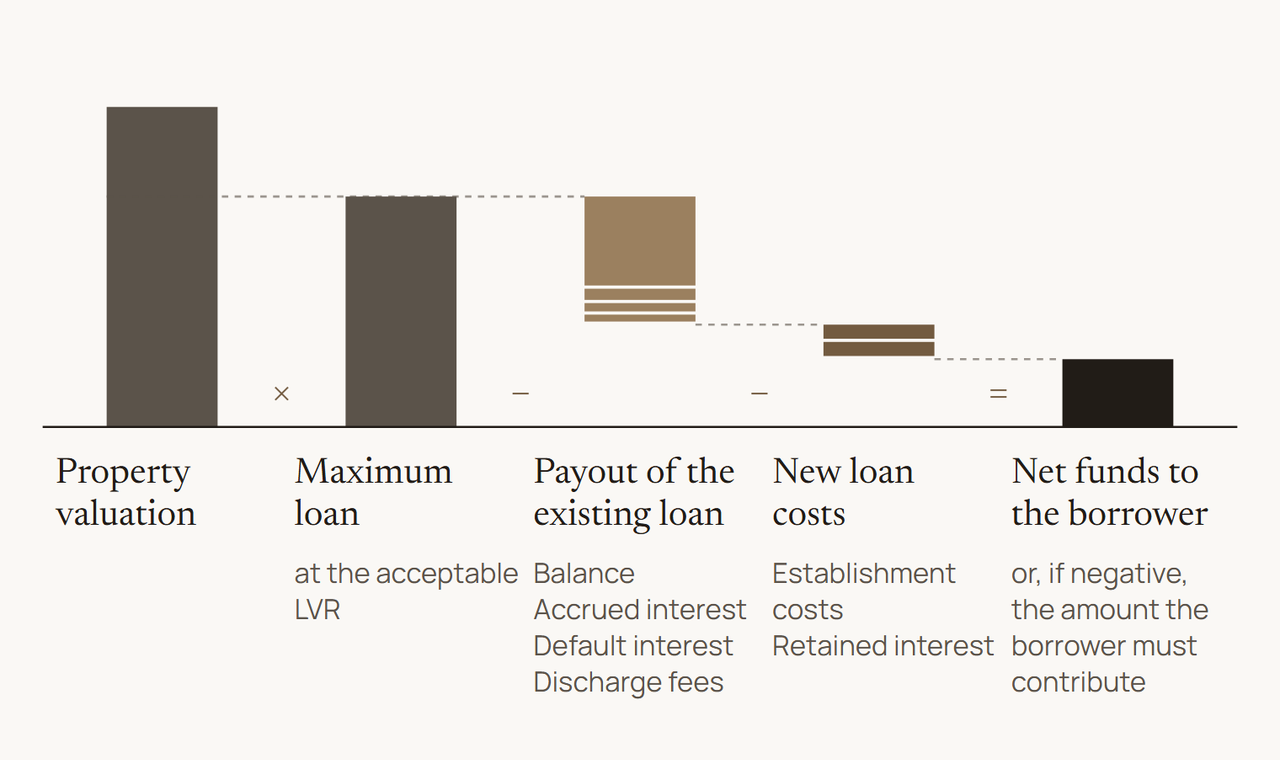
Identifying these amounts early shows whether the loan can settle, and whether the borrower needs to contribute more. The same discipline applies to the exit: will the expected sale or refinance proceeds repay the total debt at that time?
4. Loan term and cost: a workable pathway
The term should follow the purpose and the exit.
A short facility can suit a clearly defined transaction. A six-month loan needs careful thought, though, where repayment depends on approvals, construction, business recovery or a sale that may take longer.
The assessment should consider the total cost over a realistic timeframe, including the effect of delays, interest servicing and any retained or capitalised interest. The aim is a facility the borrower can use effectively and repay within a credible timeframe. Repeated extensions should not become the assumed answer to an exit that was uncertain from the start.
5. The five Cs of credit, and a sixth: common sense
The fundamentals of credit remain essential:
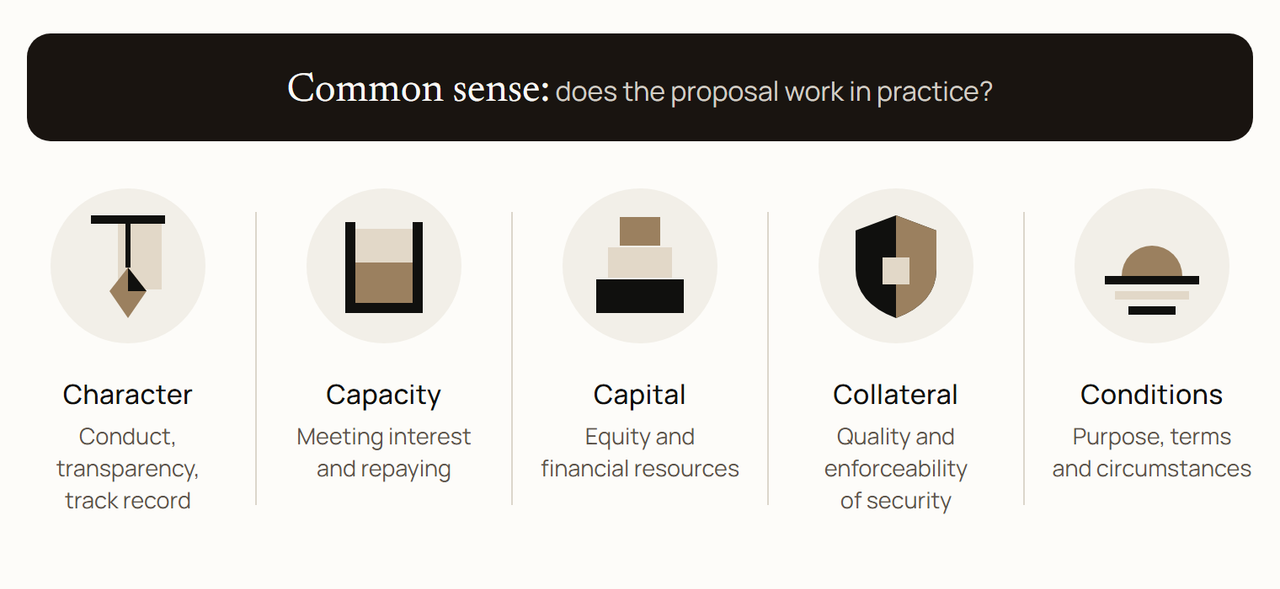
- Character: the borrower's conduct, transparency, track record and willingness to meet obligations.
- Capacity: the ability to meet interest commitments and repay the facility through a substantiated exit.
- Capital: the borrower's equity contribution, financial resources and ability to absorb setbacks.
- Collateral: the quality, value, marketability and enforceability of the security.
- Conditions: the loan purpose, facility terms, and the market or transaction circumstances affecting repayment.
The sixth C is common sense: testing whether the proposal works in practice.
- Do the assumptions fit together?
- Does the borrower have enough time and money to carry out the plan?
- What happens if the valuation is lower, costs increase or the exit takes longer?
Common sense supports disciplined credit assessment. It also means recognising when a different structure, a revised amount or a longer term would produce a more workable outcome, and when a transaction should not proceed.
Our approach
At Solomons Capital, we connect the borrower's purpose with an appropriate funding structure and a credible repayment pathway.
For broker partners, establishing these elements early helps identify obstacles before they become settlement problems. For borrowers, it gives a clearer view of the commitment they are taking on, and what it needs to succeed.
Private lending requires commercial judgement, flexibility and discipline. The five Cs remain the foundation. The sixth, common sense, should be present in every decision.
Earlier in this series: What to Do When a Lending Scenario Doesn't Fit the Bank. If you are still weighing whether a scenario suits private lending at all, it sets out what a private lender needs to assess it.
Have a scenario?
Send it to scenarios@thesolomons.com.au or call 07 3835 8581, and we will come back to you with a clear indication.
Speak with our lending team: Steven Galdona · Darren Stratford
Prepared for mortgage and finance brokers. Information is current as at November 2026 and may change without notice. Loan sizes, LVRs and lending categories are subject to Solomons Capital's lending criteria and policy, and all applications are assessed case by case. This information is general in nature and terms and conditions apply. Solomons Capital Australia Pty Ltd, ACN 635 595 309, is a Corporate Authorised Representative (CAR 1321518) of Valparaiso Australia Pty Ltd, AFSL 482050.
About the author

Steven Galdona
Director of Credit & Operations
Credit risk and lending operations, supporting the assessment and delivery of lending at Solomons Capital.
Originally published
Continue the thought
Capital & property · 22 October 2026 · Steven Galdona · 3 min read
What to Do When a Lending Scenario Doesn't Fit the Bank
A bank's no doesn't always mean a scenario is unsound. What a private lender needs to assess it, and when private lending is the right fit.